
A low-risk result is a snapshot, not a green light. A crypto token scanner can surface warning signs quickly, but its score cannot prove that a token is safe. Treat the scan as reconnaissance, then verify what matters before you act.
When a dashboard compresses contract and on-chain signals into a number, it’s reasonable to ask what that number leaves out. A high-risk flag needs context, and a reassuring score still leaves questions. This guide explains what scanners check, how to interpret scores and alerts, and where automated screening stops.
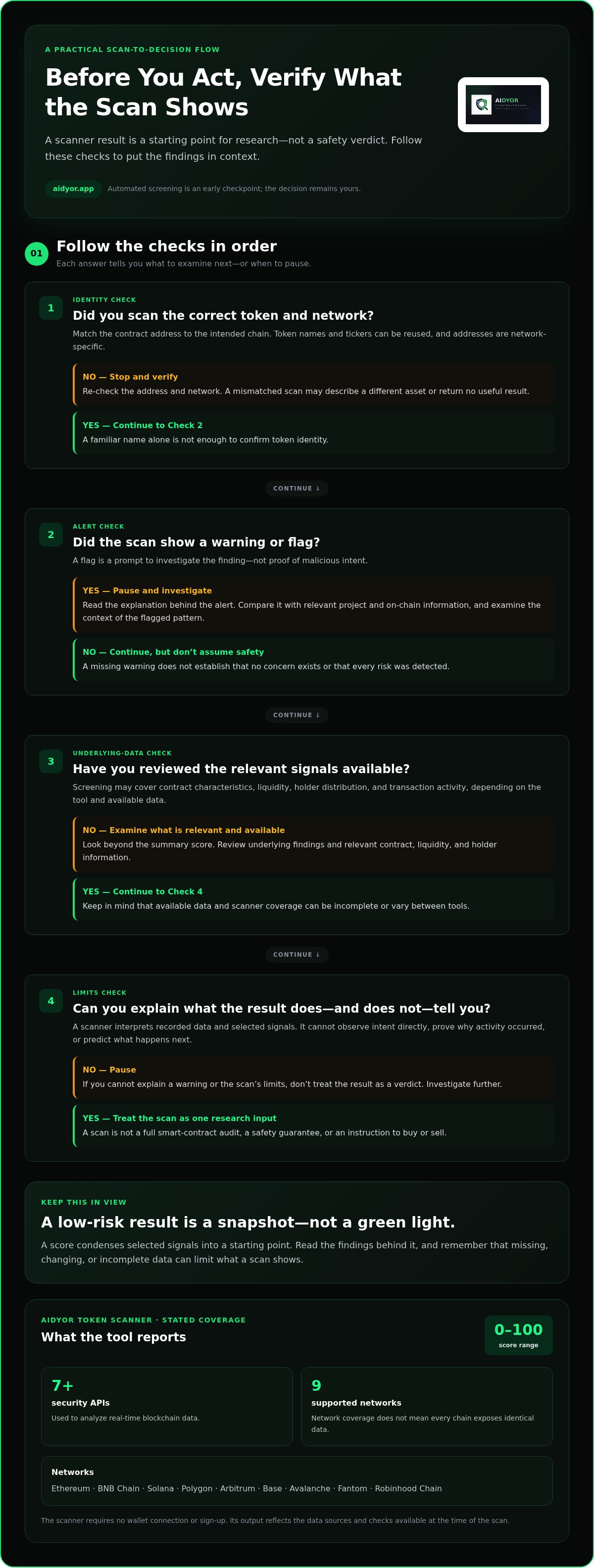
AIDYOR’s Token Scanner analyzes real-time blockchain data using 7+ security APIs and returns a score from 0 to 100. It supports nine networks, including Ethereum, Solana, Base, and BNB Chain, and requires no wallet connection or sign-up. Use it as a first pass, then verify the token and network and investigate the findings, liquidity, and holder patterns. The goal is to read risk signals without mistaking an automated scan for a verdict.
Key Takeaways
- A crypto token scanner surfaces available risk signals. It isn’t a full smart-contract audit or a safety verdict.
- Read the findings behind a score. A single number can’t show every risk or predict what happens next.
- Verify that you scanned the correct token and network, then review relevant contract, liquidity, and holder information.
- Use automated screening as an early checkpoint. Pause when warnings appear, and don’t treat a clean result as a reason to skip due diligence.
- Data coverage and interpretation can vary between scanners. Understand what a tool checked before weighing its results.
What Is a Crypto Token Scanner, and What Does It Screen?
A crypto token scanner reviews available token and blockchain data for signals that may point to risk. It gives you a quick way to check a token before deciding what to investigate further. Think of it as triage, not a final ruling.
A crypto token scanner can flag patterns in the data it checks, but it can’t establish that a token is safe, prove malicious intent, or tell you whether to buy or sell. A scan is one input for your research, not an instruction or substitute for judgment.
These tools draw on information recorded across a blockchain. If you need a refresher on how that data is stored and shared, start with this overview of Blockchain technology. A scanner can assess only the information it can access and the signals its methods are designed to interpret. Missing, changing, or incomplete data can limit what the results show.
Which token details can an automated scanner review?
Depending on the tool and data available, screening may cover contract characteristics, liquidity, holder distribution, and transaction activity. These signals can surface patterns that deserve closer attention, but they don’t tell the whole story of a project, its people, or every way a token could behave.
Scanners differ in their data sources and the way they weigh signals. A warning is a prompt to investigate the underlying finding, not proof that a team acted maliciously. For example, if a scan flags a liquidity pattern, examine the relevant pool and its context rather than concluding from one alert that the token is a scam. Treat the finding as a question to answer, not a verdict to repeat.
Context matters because a scanner’s output reflects its coverage at the time of the check. It can’t guarantee that all relevant information is available or that every risk will be detected. Read the explanation behind a flag and compare it with relevant project and on-chain information.
How is token screening different from a contract audit?
Automated screening processes available signals quickly and presents findings for follow-up. A smart-contract audit is a deeper, scoped security review of contract code and behavior. A scan result isn’t an audit report, and a scanner score doesn’t certify a contract.
AIDYOR offers scanning tools, not smart-contract audit services. Its Token Scanner and separate Smart Contract Bug Scanner Pro are scanning products, not full audits. A scan can help identify questions worth pursuing, but it can’t establish that a contract has no vulnerabilities or that a token carries no risk.
Use the scan to decide what to examine next. Check the token identity and network, inspect the findings, and pause if you can’t explain a warning. The decision remains yours.
How Does a Crypto Token Scanner Turn Blockchain Data into Findings?
A scan follows a short pipeline: it starts with an asset identifier, gathers accessible blockchain information, evaluates selected signals, then presents findings in a readable form. A crypto token scanner doesn’t observe intent directly. It works with recorded data and applies methods to interpret patterns in that data.
A scanner reports what its data sources reveal and what its checks infer; it doesn’t prove why an activity occurred or what will happen next. Keep that distinction in view as you read the output. Background from NIST blockchain research can help explain the underlying technology, but a general overview can’t validate an individual token.
- Identify the token. Select the correct network and enter or locate the token’s contract address.
- Review available data. The tool accesses relevant blockchain information and any connected security data within its coverage.
- Process signals. Automated checks organize selected patterns into findings. The exact checks and interpretation vary by scanner.
- Present results. A score, flags, or explanations condense the scan into a starting point for further research.
Why network and token identification matter
Contract addresses are network-specific. The same address format can appear on different chains, and token names or tickers can be reused. Match the address to the intended network before scanning. A familiar name alone doesn’t establish that you’ve found the project’s actual contract. If the chain or address is wrong, the scan may describe a different asset or return no useful result.
Multichain coverage helps when researching assets across ecosystems. AIDYOR supports Ethereum, BNB Chain, Solana, Polygon, Arbitrum, Base, Avalanche, Fantom, and Robinhood Chain. Coverage doesn’t mean every chain exposes identical data or that every token has the same amount of available history.
What happens between data collection and a displayed result?
After collecting data, a scanner brings selected signals together and presents them in a form that helps you prioritize what to inspect next. A concise result saves time, but it also compresses context. Open the underlying findings where available. Ask what was observed, what the scanner inferred, and what may be outside its scope.
AIDYOR analyzes real-time blockchain data using 7+ security APIs. That describes its data approach, not perfect coverage: source availability and scanner methods affect what appears in a result. Tools can differ in coverage, signal selection, and interpretation. A missing warning doesn’t establish that no concern exists, while a flag still needs context.
Use the result to set your next research step, not to outsource the decision. For a first check, you can scan a token with AIDYOR, then examine relevant project and on-chain information before acting.
How Should You Interpret a Crypto Token Scanner Score?
AIDYOR’s Token Scanner returns a score from 0 to 100. Treat it as a summary of scanner findings, not a forecast or certification. The number can help direct your attention, but the findings behind it tell you what to examine.
A scanner score is a prioritization signal, not a guarantee of safety or a prediction of future outcomes. Don’t translate a number into “safe to buy” or “certainly malicious.” A score can’t establish price performance, prove intent, or capture every factor that affects a token.
What a scanner score can, and cannot, tell you
A score condenses the tool’s checks into a quick reference. Use it to decide where to focus, then open the supporting flags and explanations. Ask what data each finding refers to, whether it applies to the token you meant to scan, and what evidence could clarify it. A useful result starts an investigation; it doesn’t finish one.
Don’t assume that a particular number corresponds to a specific risk category unless the scanner clearly defines that interpretation. Avoid inventing score bands or comparing numbers across tools as if they use the same scale. Scanners can differ in what they measure and how they combine findings. For broader due diligence, Fidelity’s guide to evaluating cryptocurrency can help frame research beyond a scanner result.
Why a clean result is not proof of safety
A reassuring result means the scan didn’t surface certain concerns within the checks and data available to it. It doesn’t rule out risks the tool doesn’t measure, information it can’t access, or issues that emerge after the scan. Conditions can change: liquidity can shift, activity can evolve, and contract behavior may depend on circumstances a single result doesn’t capture.
Don’t stop at “no flags.” Check that you have the right token and network. Review what the scan actually found, then look at relevant project information and current on-chain activity. If something is unclear or a finding raises concern, pause. A clean screen is one checkpoint, not permission to skip the rest of your research.
To interpret a crypto token scanner score, separate the number from the evidence. Note the reported findings, identify what remains unknown, and decide what needs verification before you act. Keep the operating rule simple: use the score to prioritize questions, not to make the decision for you.
How to Use a Crypto Token Scanner Before Taking Action
Build a pause into your research. A crypto token scanner can surface signals, but the result helps only if you’ve identified the right asset and follow up on what it reports. Don’t let a trending post, urgent countdown, or sudden price move rush you past basic checks. Scan first, verify, then make your own decision.
A practical pre-action screening sequence
Start with the token’s contract address and blockchain, not just its name or ticker. Compare both with reliable project information. Then run the scan and read the findings individually. Note anything you can’t explain, and compare those signals with project details and on-chain information before deciding what to do next.
- Locate the intended token. Match its contract address to the correct blockchain. Similar names and tickers can refer to different assets.
- Run the scan. Check that the result corresponds to the token and network you intended to research.
- Read each finding. Note what the scanner reports, what evidence it points to, and what remains unclear. Don’t rely on the overall score alone.
- Cross-check and pause. Compare the result with independent project information and relevant on-chain data. If important details conflict or are missing, stop and investigate before acting.
What to do when a scan flags risk
Pause. A serious or unclear flag calls for more research, not a rushed transaction or an automatic accusation. Read the explanation, identify what it establishes, and separate that from assumptions about intent or future behavior. If you can’t verify the concern or understand its implications, don’t treat the result as resolved.
Use the finding to choose a focused next check. Depending on the alert, that might mean reviewing project disclosures or looking more closely at liquidity, holder concentration, or scam indicators. Each topic needs its own checks; a scanner flag alone doesn’t complete them. An unflagged result doesn’t prove that all is clear, either.
- Finding is clear and corroborated: Consider what the evidence means alongside your other research.
- Finding is unclear: Seek context before drawing conclusions or taking action.
- Sources conflict or key data is missing: Stay on pause until you understand the gap.
Keep the workflow simple: verify the asset, inspect the evidence, cross-check, and pause when uncertainty remains. For a first-pass check, scan the token with AIDYOR, then use the findings to guide your next research step.
Use AIDYOR as a First-Pass Crypto Token Scanner
AIDYOR’s Token Scanner offers a practical first screen before deeper research. It analyzes real-time blockchain data using 7+ security APIs and returns a score from 0 to 100. Use the result to identify findings worth examining, not as a final judgment on a token.
What AIDYOR’s Token Scanner offers
The Token Scanner is free to use and requires no wallet connection or sign-up. That makes it straightforward to begin checking a token. It supports nine networks: Ethereum, BNB Chain, Solana, Polygon, Arbitrum, Base, Avalanche, Fantom, and Robinhood Chain.
Network coverage helps when your research spans different chains, but it doesn’t mean every network or token exposes identical data. A score reflects the scan’s findings from available information and its screening methods. Review the result, verify the token address and chain, and follow up on anything that needs context.
Keep the tools distinct. AIDYOR’s Token Scanner provides an initial token screening and score. Smart Contract Bug Scanner Pro is a separate offering for smart-contract bug scans. Neither is a comprehensive smart-contract audit, and no automated scan can guarantee that every risk will be identified.
When to continue research after a scan
Continue your checks whenever a finding is severe, unclear, or inconsistent with other information. A result with no visible warning also isn’t proof that a token is safe. Project details and on-chain conditions can change, and an automated screen is only one input in your research.
Use the report to form specific questions. What data supports a flag? What does it leave unestablished? Which details should you verify? A score can help prioritize those questions, but it can’t predict price performance or settle a decision for you.
When comparing token scanners, focus on coverage, findings, and limitations. Don’t assume that scores from separate tools use the same methods or mean the same thing.
Start with a scan, then make time for verification. Scan a token with AIDYOR.
Make Due Diligence Your Default
Make your research repeatable. Before acting on a token, give yourself room to question the signal, verify what matters, and walk away if uncertainty remains. Hype rewards speed. Careful research keeps the decision in your hands.
Keep a short record of unresolved questions as you research. If a claim, contract detail, or project update doesn’t add up, treat the gap as a reason to pause, not a challenge to rush through. A crypto token scanner can support that process, but your decision should rest on evidence you understand.
Put the habit into practice with Scan a token with AIDYOR. Use the result as a starting point for your own checks, and move forward only when you’re comfortable with what you’ve verified. You don’t need certainty to make a considered decision, but you do need to stay alert and in control.
Frequently Asked Questions
What is a crypto token scanner?
A crypto token scanner reviews available token and blockchain data for signals that may deserve closer attention. Think of it as an early research filter, not a decision engine. If a search returns several tokens with the same ticker, compare the contract address and network with the project’s official information before relying on a scan. Then read the finding itself, not just its label.
Is a crypto token scanner enough to tell whether a token is safe?
No. A scan can assess only selected signals in the data and methods available to it. It can’t account for every risk or certify future behavior. A clean result doesn’t establish that a project’s claims are accurate, either. Before acting, check relevant project information and current on-chain activity. If those sources conflict with the scan, treat the discrepancy as an open question rather than choosing the more reassuring answer.
Can I scan a token without connecting my wallet?
Yes. AIDYOR’s Token Scanner requires no wallet connection or sign-up, so you can review a token without connecting a wallet. That’s useful during early research: a screening check doesn’t require you to connect the wallet you use to hold assets. Still, verify the contract address and chain independently. A familiar token name or logo alone doesn’t confirm that the scanned contract belongs to the project.
What does a 0-100 crypto token risk score mean?
It summarizes findings according to the scanner’s scoring method. AIDYOR displays a 0-100 score, but don’t assume another scanner uses the same calculations or that particular numbers have universal meanings. Avoid inventing a threshold such as “below this score is safe.” Instead, open the available findings, note what evidence they refer to, and use the score to prioritize questions for your next checks.
Which blockchains can AIDYOR scan?
AIDYOR’s Token Scanner supports Ethereum, BNB Chain, Solana, Polygon, Arbitrum, Base, Avalanche, Fantom, and Robinhood Chain. Before scanning, confirm the network as well as the token address. A project may have different contracts across chains, and a matching name elsewhere can point to a separate asset. Supported networks don’t necessarily provide identical information for every token, so interpret each result in context.
Does a crypto token scanner replace a smart-contract audit?
No. Token scanning and a smart-contract audit are different. A scanner surfaces selected signals for initial research; an audit is a separate, deeper review with a defined scope and methodology. Don’t treat a screening result as evidence that every contract path was examined. AIDYOR offers scanning tools, including its separate Smart Contract Bug Scanner Pro, but its Token Scanner is not a smart-contract audit service.
What should I do if a token scanner flags a risk?
Pause and inspect the specific finding before taking action. Confirm that you checked the intended contract and network, then identify what the flag actually reports. For instance, a warning about a contract property doesn’t by itself prove that the project is a scam. Look for relevant context in project information and on-chain data. If the finding remains unclear or conflicts with other evidence, don’t rush past that uncertainty.
Can a token’s risk change after I scan it?
Yes. A scan reflects information available at the time it runs, and token conditions can change afterward. Updated project information or a shift in on-chain activity may make an earlier result less relevant. Treat a past scan as a time-specific reference, not permanent clearance. If circumstances change or you revisit a token after a delay, run a fresh check and reassess the current findings.