
What if a reassuring crypto token risk score tells you less than you think? A single number can summarize detected signals, but it may hide which contract or liquidity risks shaped the result. When scanners disagree, that doesn’t automatically mean one is broken. They may analyze different data or apply different methods.
A score can still help you triage a token. Read it as a signal, not a safety verdict. This article explains what a token score can summarize, why results may vary between scanners, and where automated checks can fall short. You’ll learn how to inspect the underlying signals and use the number as one input in a cautious research process.
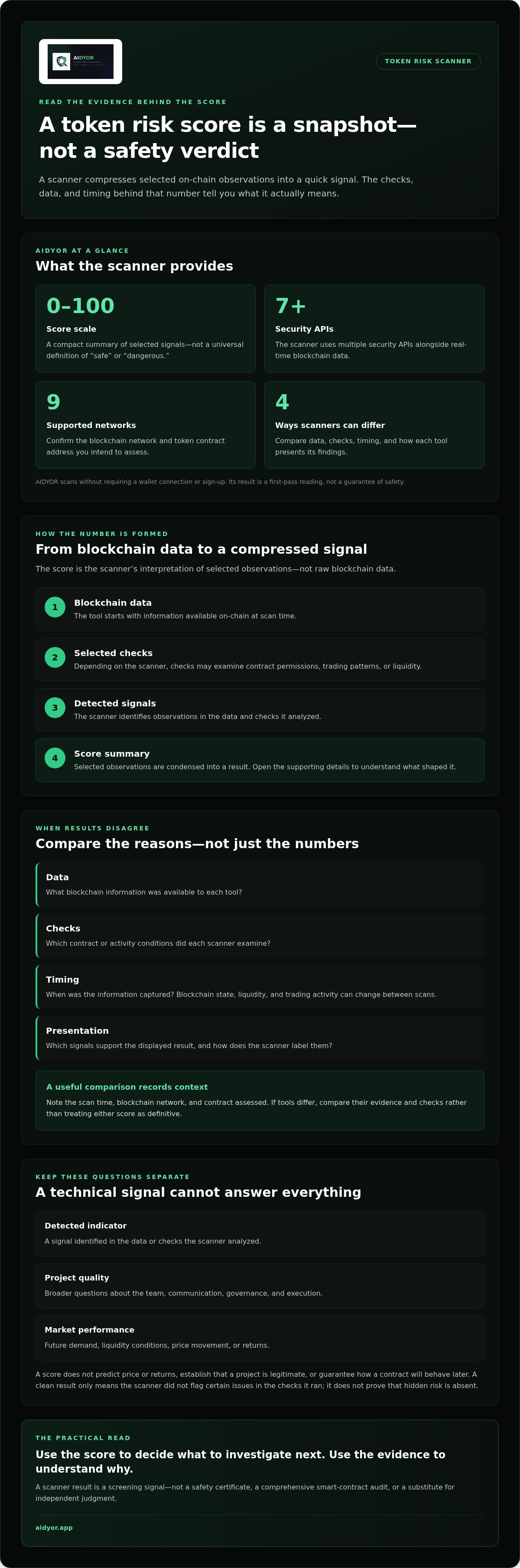
AIDYOR’s Token Scanner returns a 0-100 score using real-time blockchain data and 7+ security APIs across nine supported networks. You can scan without connecting a wallet or signing up. Treat the result as a first-pass reading, not a guarantee of safety, an investment forecast, or a substitute for independent judgment or a professional audit. The details behind the number matter more than the number alone.
Key Takeaways
- A crypto token risk score reflects selected indicators at scan time, not a forecast of price or returns.
- Check the evidence behind the number. The signals can reveal more than the headline score alone.
- Different scanners may reach different results because their data, checks, timing, and presentation can vary.
- Before acting, confirm the blockchain network and token contract address so you’re assessing the intended asset.
- Use a scanner result to guide further research, not as proof that a token is safe or a substitute for independent judgment.
What a Crypto Token Risk Score Measures, and What It Cannot Tell You
A crypto token risk score is a scanner’s summary of selected risk signals detected at the time of a scan. It compresses observations into a quick reference point, but doesn’t show every detail the scanner examined or account for everything that may happen next. Treat it as a snapshot, not a permanent verdict.
The general idea is to turn risk-related information into a score that’s easier to compare or act on. What is a Risk Score? offers a broad explanation of this approach. In crypto, the meaning of a displayed score depends on the scanner’s data, checks, calculation method, and labels.
What does a 0-100 crypto token risk score represent?
A 0-100 scale puts multiple observations into one compact signal, but the scale alone doesn’t explain what a particular number means. Don’t assume a value equals “safe,” “moderate,” or “dangerous” unless the scanner defines it that way. Read the tool’s labels and guidance, then open the supporting details. If the result gives a number without explaining what informed it, you have less context to judge its usefulness.
Think of the score as an alert on a dashboard. It directs your attention; the evidence behind it tells you what to investigate.
What a token risk score cannot establish
A scanner can report detected technical indicators. That doesn’t prove a project is legitimate, well-managed, or likely to perform well in the market. A score doesn’t predict price, returns, or whether a token will retain value. Those are separate questions the number can’t answer.
Automated checks also have limits. They assess selected data and conditions available at scan time, but can’t guarantee how a contract will behave later, whether permissions will change, or what a project team will do. A clean result means only that the scanner didn’t flag certain issues in the checks it ran. It doesn’t prove that no hidden risk exists.
- Detected indicator: A signal the scanner identified in the data or checks it analyzed.
- Project quality: Broader questions about the team, communication, governance, and execution.
- Market performance: Future demand, liquidity conditions, price movement, or returns.
These categories can overlap in real-world decisions, but don’t collapse them into one verdict. A token may have no obvious technical flags and still involve serious project or market uncertainty. A scanner result also isn’t a comprehensive smart-contract audit. It may help surface issues, but it doesn’t certify the full contract or guarantee safe use.
A token score is a screening signal, not a safety certificate. Use it to decide what deserves closer review. Don’t use it as permission to stop researching or take action without understanding the evidence.
How Crypto Token Risk Scores Turn On-Chain Signals into a Summary
A scanner starts with blockchain data, runs selected checks, identifies signals, then presents a result. The final number isn’t raw blockchain data. It’s the tool’s interpretation of selected observations, shaped by what it checks and how it summarizes what it finds.
On-chain observations are the evidence; a scanner score is a compressed interpretation of that evidence. Keep those separate as you read a result. The number can help you orient quickly, while the underlying signals show what the tool actually detected.
Which kinds of signals may inform a token assessment?
Scanners may examine broad categories such as contract behavior and token activity. Depending on the tool, checks might look at contract permissions or trading patterns. Liquidity can also matter when assessing whether trading activity is supported by available pool depth. These are common scanner concepts, not a description of AIDYOR’s scoring formula or a guarantee that every scanner checks the same items.
Follow each signal to its source. If a result flags a contract condition, identify the specific behavior being reported. If it raises an activity or liquidity concern, review the supporting data and its time context. Use a dedicated liquidity guide if you need to understand liquidity measures in more depth. Don’t assume one score captures every dimension.
Why scanner data and results can differ
Two tools can analyze the same token and return different scores because they may rely on different data sources, inspect different contract conditions, or present signals differently. Even tools that check similar factors may process updates at different times.
Blockchain state and token activity can change between scans. A pool’s liquidity or a token’s trading pattern may shift, so results captured at separate times aren’t necessarily direct comparisons. Record the scan time and note the chain and contract assessed. If another tool gives a different result, compare the evidence and checks rather than treating either number as definitive.
Risk scoring can also serve different purposes. The U.S. Department of the Treasury’s Illicit Finance Risk in Decentralized Finance report discusses illicit-finance risks in DeFi. That broader context is useful, but it doesn’t mean every token scanner measures illicit finance specifically. Read the scanner’s stated scope before interpreting its score.
- Data: What blockchain information was available to the tool?
- Checks: Which contract or activity conditions did it examine?
- Timing: When was the information captured?
- Presentation: Which signals support the displayed result?
No scanner’s number is a universal rating. Use it as a starting point, then inspect the evidence. A quick first-pass reading from AIDYOR’s token scanner can help you begin that review without connecting a wallet.
How to Interpret a Crypto Token Risk Score Without Overtrusting It
Start with the scanner’s own explanation. A number or color means little without knowing how the tool defines it. Don’t assume that a higher or lower score signals greater danger until you’ve checked the labels and guidance. Scanners may use different scales and methods, so their results aren’t automatically comparable.
The evidence behind a score matters more than the number alone. Use the number to orient your review, then inspect what the scanner detected, what it checked, and what remains unanswered.
Read the score together with its supporting indicators
Separate the scanner’s reported observation from your conclusion about its significance. For example, a tool might report a contract permission or an unusual activity pattern. That’s a signal to investigate, not by itself proof of malicious intent. Look at the detail behind the alert, then consider what it could mean in context.
Token-holder distribution is another area to research. Concentrated ownership may raise questions about how much influence a small number of holders could have, but the score alone may not explain that picture. Review holder data directly when concentration risk is relevant.
| What you see | What to examine | What remains unanswered |
|---|---|---|
| Displayed score or label | The scanner’s explanation of the scale and its stated scope | Whether the result covers every risk you care about |
| Reported signal | The specific check, observation, and relevant context | How serious the signal is for this token and your situation |
| No visible alert | Whether the check ran and returned a clear result | Whether other risks were outside the scan’s scope |
Treat missing or unclear evidence as uncertainty
No alert isn’t proof of safety. Distinguish a completed check with no issue reported from data that’s unavailable, inconclusive, or not shown. A scanner may present these states differently, and tools don’t necessarily display the same findings or confidence information.
If the result doesn’t explain an important signal, don’t fill the gap with assumptions. Mark the question as unresolved and seek relevant evidence through further research, rather than treating silence as a clean bill of health.
- Read the label: Confirm how the scanner describes the score before judging its direction or severity.
- Trace each alert: Identify the observation behind it before deciding what it means.
- Flag gaps: Separate clear results from checks with missing or unclear evidence.
This approach keeps a crypto token risk score in its proper role: a prompt for focused review. It helps you ask better questions, not skip judgment.
How to Use a Token Risk Score Before Taking Action
Turn the scan into a pause point, not an automatic buy or sell signal. Follow a simple sequence: confirm the asset, scan it, inspect the evidence, then decide whether to continue researching or stop. Each step reduces the chance of acting on the wrong token or reading more into a score than it supports.
Check the token and network before reading the result
A token name or ticker isn’t a unique identifier. Similar names can appear on different networks, and an asset on Ethereum isn’t interchangeable with one on Solana. Match the network and contract address against the source where you found the token. Then select that network in the scanner. If the address or chain doesn’t match, stop. A result for the wrong contract tells you nothing reliable about the asset you intended to assess.
Use this order:
- Identify the asset: Confirm the blockchain network and token contract address, not just the name or ticker.
- Run the scan: Select the matching supported network and submit the intended contract.
- Review the evidence: Read the scanner’s explanation and supporting signals before interpreting its score.
- Choose your next step: If findings are concerning or unclear, pause and investigate further before interacting.
Decide what to do when the result raises questions
Don’t let a single number make the decision for you. A crypto token risk score can help you prioritize what to review, but it can’t make an automatic buy decision or settle questions the scan leaves open. Pause if an alert is unexplained, the result doesn’t match your expectations, or the scan assessed an uncertain address. Resolve the mismatch first. If you can’t establish what a finding means, treat that uncertainty as a reason not to rush.
Keep the workflow focused. Trace the result to its evidence, identify the remaining question, and decide whether you have enough information to continue your research. A broader token-scanner guide can help when you need to explore risk signals beyond score interpretation.
AIDYOR’s Token Scanner offers a first-pass reading across nine supported networks. It uses real-time blockchain data and draws on 7+ security APIs. Scanning doesn’t require connecting a wallet or signing up. The result can support your research, but it isn’t a safety guarantee or a substitute for independent judgment.
Try AIDYOR’s Token Scanner to review a token’s score and the signals behind it before deciding what to investigate next.
How AIDYOR Gives You a First-Pass Crypto Token Risk Read
AIDYOR’s Token Scanner gives you a starting point for reviewing a token. It analyzes real-time blockchain data using 7+ security APIs across nine supported networks, then returns a score from 0 to 100. Use that result as reconnaissance: a way to focus your next research steps, not a ruling on whether the token is safe.
What AIDYOR’s Token Scanner provides
The scanner supports Ethereum, BNB Chain, Solana, Polygon, Arbitrum, Base, Avalanche, Fantom, and Robinhood Chain. Select the network that matches the token you want to examine. The same name can refer to different assets on different chains, so confirm the contract address too. A scan of the wrong deployment won’t answer questions about the token you intended to review.
You can use the scanner without connecting a wallet or signing up. The scan is separate from wallet access. Its result is a 0-100 score, but don’t assign meaning to a particular number without consulting the scanner’s displayed explanation. Focus on the evidence and scope shown with the result. The APIs and real-time data support a first-pass view, but they don’t mean every possible issue will be detected.
Keep the tool’s role clear. A scanner result is not a comprehensive smart-contract audit. It doesn’t hold assets, execute transactions, or predict how a token will perform in the market. It summarizes selected signals available to the scan. Your judgment still matters.
Use the scan as reconnaissance, not a final decision
Read the score alongside its displayed evidence and the context in which you’re assessing the token. If a finding is unclear, pause and investigate before interacting. If the scan returns no obvious warning, don’t treat that as proof that the asset carries no risk. The result can help you decide what to examine next, but it cannot guarantee safety or future contract behavior.
The distinction is simple: the scanner supplies a signal; you evaluate what that signal does and doesn’t establish. Use it to sharpen your research, not replace it or make an automatic buy decision. A favorable number is not a forecast of returns, and a concerning result is a prompt to understand the evidence, not an explanation by itself.
For a quick first-pass crypto token risk score, scan the correct contract on its matching network, then review the result before taking action. Scan a token with AIDYOR and use the findings to guide your next research step.
Make Your Next Token Check Deliberate
Before reviewing another token, decide what evidence you need before you’re willing to act. That rule helps you avoid moving the goalposts when a result looks reassuring or dismissing a warning because you’re eager to proceed. Keep unresolved questions visible. If the evidence doesn’t answer them, pause rather than forcing a decision before your research is ready.
A crypto token risk score can direct your attention, but disciplined judgment is what turns a signal into a sound next step. Check the details, stay curious, and be willing to walk away when uncertainty remains.
Put that approach into practice with your next token review. Scan a token with AIDYOR, then use what you learn to guide your own research. You’re in control of the decision, and a careful pause is progress.
Frequently Asked Questions
Is a crypto token risk score the same as a smart-contract audit?
No. An automated score summarizes selected checks, while an audit is a separate, deeper review process. Audit scope can vary, so don’t assume every audit examines the same components or conditions. A scanner result should not be represented as an audit or certification. Check what the scan covers and leaves out. For example, a score alone doesn’t establish that every contract permission or edge case received manual review.
Can a crypto token risk score predict its price or future returns?
No. A security-oriented crypto token risk score isn’t a price forecast or investment-return model. Contract behavior and on-chain indicators may highlight technical concerns, but they don’t establish whether demand will rise or a token will gain value. Keep technical risk assessment separate from financial decisions. A favorable score doesn’t make a token a good investment, and a concerning score doesn’t explain how its market price will move.
Why can two crypto token scanners give different risk scores?
Scanners can differ because they may use different data sources, checks, update timing, and scoring methods. A difference doesn’t automatically prove either result is wrong. Compare the specific findings, the checks each tool describes, and the timestamp of each scan. For example, a token update between scans may affect the available data. Treat results as separate assessments, not interchangeable readings on a universal scale.
How often should I rescan a crypto token?
There’s no single rescan interval that fits every token or use case. Consider scanning again if on-chain conditions or token activity may have changed, or before a consequential interaction. Check the timestamp to see when the result was produced. A scan from an earlier period describes the information available then, not necessarily the current state. Don’t mistake a one-time scan for continuous monitoring.
Can the same token have different risk scores on different blockchains?
Yes. Similarly named or bridged assets on separate networks can have distinct contract addresses and on-chain behavior. A result for one deployment doesn’t automatically apply to another. Before scanning, match both the network and contract address to the asset you intend to review. For example, don’t assume a token’s Ethereum deployment and its Solana counterpart share the same contract conditions or scan result.
What should I do if a token scanner cannot return a score?
Treat an unavailable score as unresolved, not as a clean bill of health. The asset, selected network, contract address, or available data may not support a meaningful result at that moment. Recheck the network and address for input errors. If they match, don’t infer safety from missing output. Wait until you can assess relevant evidence, and avoid interacting while a material question remains unanswered.

