
A token can look liquid right up until you try to exit. A large pool figure or busy 24-hour volume chart can inspire confidence, but neither guarantees your swap will execute near the displayed price. To check crypto token liquidity, focus on the specific pool behind your trade and ask: can it absorb your order without severe price impact?
Getting in may be easy, but getting out cleanly is the real test. This guide explains how to locate the correct trading pair, inspect pool reserves and depth, compare volume with available liquidity, and estimate how your trade could move the price. You’ll also learn why a liquidity-lock claim is one signal, not proof that a token is safe.
Use liquidity as an exit-condition check, then broaden your review. AIDYOR’s Token Scanner analyzes real-time blockchain data across nine supported networks and returns a 0-100 score. It’s a complementary token-risk check, not a dedicated liquidity measure or safety guarantee. First assess whether the pool can handle your trade, then weigh that finding alongside other token risks.
Key Takeaways
- To check crypto token liquidity, identify the exact token, chain, DEX, and trading pair before relying on a pool figure.
- Compare pool depth with your planned order size. A large headline number alone won’t show how much your swap could move the price.
- Preview the swap and separate trade-driven price impact from network fees before you approve a transaction.
- Treat liquidity-lock claims as one data point. Review contract behavior, ownership, and sellability to build a broader risk picture.
What crypto token liquidity tells you about whether a trade can exit
Liquidity is a market’s capacity to absorb swaps without causing a disproportionate price move. For a token, assess the specific pool or order book you plan to trade against. That market determines how much of the paired asset is available to exchange at prices near the current quote. A token may be easy to buy in a small amount but difficult to sell in a larger one.
Liquidity affects both sides of a trade. A shallow pool can push the execution price against you as you buy, then do the same when you exit. The quoted price may also differ from the final execution price if the pool changes before your transaction is processed. That gap is slippage, and it makes the outcome less predictable.
Liquidity supports trading; it does not establish that a token is safe. A pool can be active and still involve contract, ownership, or sellability risks. Treat liquidity as one signal in your assessment, not a verdict on the token.
Liquidity, pool depth, and trading volume are different signals
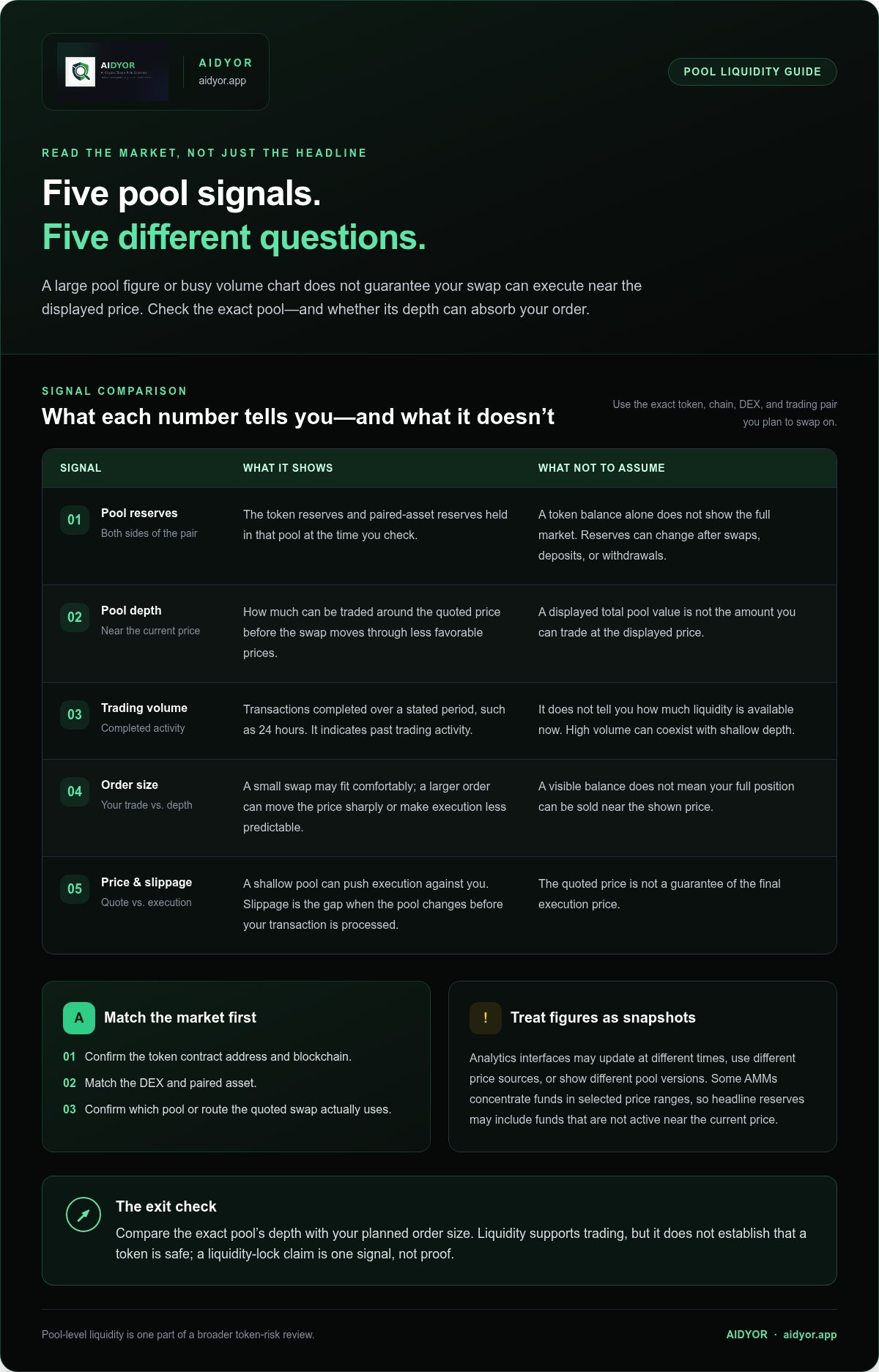
Pool depth describes the assets available around the current trading price. In a token-to-asset pool, examine both sides: the token reserves and the paired-asset reserves. The amount available near the quoted price matters because a trade may move through less favorable prices as it consumes those reserves.
Trading volume measures completed transactions over a stated period, such as 24 hours. It shows past activity, not how much liquidity is available now. High volume can coexist with shallow pool depth if traders repeatedly swap small amounts or if activity is concentrated in a brief burst. Volume also doesn’t prove that liquidity will remain in place when you need to exit.
Keep the scope precise. A token’s pool on one DEX is not the same as its liquidity across every exchange or trading pair. A market-wide figure can combine venues, chains, and pairs that your transaction may not access. To check crypto token liquidity, inspect the exact pool you intend to use.
Why token liquidity matters when you plan to swap
Your order size changes the test. A small swap may fit comfortably within a pool, while a larger one can move the price sharply or make execution less predictable. Thin liquidity can make an exit harder or more costly, especially if the pool has limited paired assets. Don’t assume a displayed balance means your full position can be sold near the shown price.
Start with the exact market, then compare its depth with the amount you plan to trade. Broader research matters too. A crypto token scanner guide can help you consider other token-risk signals alongside pool conditions. For foundational context on the asset class, see What is cryptocurrency?
How a DEX liquidity pool works, and what its numbers show
A decentralized exchange (DEX) often uses an automated market maker, or AMM, instead of matching buyers and sellers through a traditional order book. Traders swap against a liquidity pool containing two assets. The AMM’s rules use the pool’s reserves to calculate a price, and each swap changes those reserves. Learn more about Understanding cryptocurrency liquidity and how available liquidity can influence price behavior.
Assess a token against its paired asset in a specific pool on a specific DEX. A token paired with a stablecoin is a different market from the same token paired with a network’s native asset. Pool reserves, displayed value, and depth can all change after swaps, liquidity deposits, or withdrawals. They’re snapshots, not permanent properties of the token.
A pool’s displayed total value is not the amount you can trade at the displayed price. It values the pool’s assets, while executable depth depends on how much of your trade can be filled before the price moves beyond an acceptable range.
Find the correct token pair and blockchain
Start with the token’s contract address and network. Match both against the pool listing. A familiar name or ticker isn’t enough because different contracts can use similar labels. Then confirm the DEX and paired asset. A listing for the right token on the wrong chain, or a lookalike token with a different contract, tells you nothing reliable about the pool you intend to use.
Read pool reserves, depth, and recent activity together
Inspect both sides of the pair, not just the token balance. Note when the data was updated, then compare recent swap activity with the available reserves. Activity shows that trades occurred; it doesn’t prove the pool can absorb a larger order or retain its liquidity.
Figures can differ across analytics interfaces. A dashboard may update at a different time, calculate asset values using a different price source, or display a different pool version. Some AMMs also let liquidity providers concentrate funds within selected price ranges. In that design, the headline reserve total may include funds that aren’t active near the current price. Check crypto token liquidity at the pool level, and review the pool details before comparing figures.
Use the numbers as a live snapshot. If reserves change between your review and execution, trade conditions can change too. An analytics page may aggregate several pools, while your swap route uses only one or a subset. Confirm which pool or route the quoted trade actually uses. That distinction prevents a broad market figure from being mistaken for the depth available to your transaction.
After reviewing the pool, broaden your risk check. AIDYOR’s Token Scanner analyzes real-time blockchain data using 7+ security APIs across nine supported networks and returns a 0-100 score. It complements pool-level research; it isn’t a dedicated liquidity checker or a guarantee of safety. You can use the Token Scanner for another token-risk check without connecting a wallet or signing up.
How to judge liquidity depth, price impact, and liquidity-lock claims
A pool’s headline value can look substantial while your particular trade still faces poor execution. Test the amount you intend to swap against the pool’s available depth. Then examine what a liquidity-lock claim actually covers. These checks answer different questions: one estimates trade conditions; the other concerns whether a liquidity provider can withdraw specific pool assets.
Use trade size and price impact to assess practical depth
Enter your intended amount in the DEX’s swap preview, but don’t approve the transaction yet. Review the estimated output and price impact. Then compare that result with a smaller trade in the same pair. If the larger order produces much less output per token, it consumes more available depth and shifts the pool’s price further.
Price impact is the change in execution price caused by your trade moving through the pool. It isn’t the network fee. Network fees pay for transaction processing; price impact reflects the pool’s pricing response. A swap preview may also show slippage tolerance, the execution-price movement you’re willing to accept before the transaction reverts. Don’t confuse that setting with a prediction of the final price.
There’s no universal liquidity threshold that makes a trade safe. Acceptable impact depends on your order size, the asset, the route, and the conditions you’re willing to accept. Compare the same order size with the pool’s usable depth, not just its displayed total. A large order that looks manageable on a dashboard can still get an unfavorable quote in the actual swap interface.
AMM pools rely on assets supplied by liquidity providers, but pool designs and withdrawal mechanics vary. How DEX liquidity pools work offers more background on provider participation. For your decision, focus on whether the claimed lock applies to the exact pool and the liquidity position behind it.
Interpret liquidity locks without treating them as a safety guarantee
A lock may restrict a liquidity provider from withdrawing covered assets until a stated unlock time. Burned liquidity-provider (LP) tokens may indicate that the holder has given up the ability to redeem that specific position. Neither claim automatically covers every pool, every token, or future liquidity added elsewhere.
Locked liquidity alone does not prove that a token or its contract is safe. Verify the chain, pool address, lock duration, and the on-chain record behind the claim. Check that the locked or burned LP tokens correspond to the pair you’re assessing. A project may point to a lock for a different pool, or the lock may expire before your intended holding period.
Even a genuine lock addresses only a narrow withdrawal risk. It doesn’t prevent privileged contract functions, concentrated token ownership, or restrictions that could interfere with selling. Keep those checks separate. To check crypto token liquidity, combine the swap preview with verifiable pool data, then assess contract controls and ownership independently.
How to check crypto token liquidity step by step before a swap
Use this checklist before approving a transaction. Record what you can verify, and separate observed data from assumptions. Liquidity displays can change quickly. A number without a clear pool, pair, or update time isn’t a reliable basis for a trade.
- Verify the token contract and chain. Get the contract address from a source you trust, then match it exactly on the intended blockchain. Don’t rely on a ticker, logo, or token name alone. Lookalike tokens can appear in search results with separate contracts and separate pools.
- Locate the exact pool. Confirm the DEX, token pair, network, and route you expect to use. Check that the paired asset is correct, whether it’s a stablecoin or the network’s native asset. A pool for a similarly named token or a different pair won’t show the liquidity available for your swap.
- Inspect and record the current data. Note the displayed depth or reserves on both sides of the pair, the paired asset, and the data’s update time. If an analytics interface combines several pools, identify which pool your trade will actually use. Treat missing timestamps, mismatched addresses, and conflicting figures as unresolved signals, not proof of strong liquidity.
- Preview your intended trade size. Enter the amount you plan to swap in the DEX interface and review the estimated output and price impact before approving. Compare the quote with a smaller amount if needed. A displayed pool total doesn’t tell you how much output you’ll receive for your specific order.
- Review controls and recheck before execution. Confirm the quote still reflects the intended pair and route. Check the transaction details, including slippage settings, before signing. If data is stale, contradictory, or difficult to verify, stop. Don’t fill gaps with assumptions or proceed just because a chart looks active.
Keep the evidence in view: contract address, chain, pool, paired asset, observed depth, update time, and swap preview. This record helps distinguish what the interfaces show from what you’re inferring. If two sources disagree, verify that they display the same contract, pool version, route, and data time before drawing a conclusion.
Pool checks are only one part of due diligence. Use a token scam-check checklist to investigate broader warning signs. After reviewing pool conditions, run a complementary token-risk check with the AIDYOR Token Scanner. It analyzes real-time blockchain data and returns a 0-100 score, but it isn’t a dedicated liquidity checker or a guarantee of safety.
What a liquidity check can, and cannot, tell you about token risk
A liquidity review answers a narrow question: what does the pool appear able to support when you inspect it? It can’t confirm that a token is safe, that you’ll be able to sell later, or that current conditions will persist. Reserves can change. Liquidity providers can remove funds, and market conditions can shift before your transaction executes.
Keep the evidence in separate lanes. Pool depth relates to swap capacity. Contract behavior concerns what the token’s code allows. Holder concentration shows how supply is distributed. Sell restrictions may affect whether a transfer or sale can complete. A favorable reading in one lane doesn’t erase a warning in another.
Combine pool evidence with independent token-risk checks
Use pool data to assess the trade conditions you observed. Then investigate contract behavior, ownership concentration, and sellability independently. For example, visible pool depth doesn’t rule out a contract control that affects transfers. A low concentration of holders doesn’t prove that the pool can handle your intended trade. Treat each finding as a distinct piece of evidence.
AIDYOR’s Token Scanner can add a broader token-risk check after you inspect the pool. It analyzes real-time blockchain data using 7+ security APIs across Ethereum, BNB Chain, Solana, Polygon, Arbitrum, Base, Avalanche, Fantom, and Robinhood Chain. The scanner returns a 0-100 score. That score is not a guarantee of safety, a dedicated liquidity measurement, or a trading recommendation. Use it as one input, not a verdict.
Run a wallet-free scan as a complementary research step
You can use the Token Scanner without connecting a wallet or signing up. That makes it a separate research step, not a replacement for checking the exact pool and previewing your intended swap. Keep your conclusion measured: record what the pool data shows, note what remains uncertain, then compare it with other available token-risk information.
To check crypto token liquidity responsibly, treat the result as a snapshot, not a promise about your future exit. If pool data is unclear or other risk signals conflict, pause rather than forcing a confident conclusion. A scan can broaden your review, but it can’t remove uncertainty or guarantee an outcome.
After checking the pool, scan a token with AIDYOR as a complementary research step. Review the result alongside pool conditions and your own checks before deciding what to do next.
Make your next trade decision evidence-led
Before acting, decide what evidence would change your mind. If the pool’s current data is unclear, the quote shifts sharply at your intended amount, or another risk signal conflicts with your expectations, pause. Skipping a swap is a valid outcome of research. Conditions can change, so reassess the pool when you’re ready to trade instead of relying on an old snapshot.
Use liquidity findings as a prompt for wider due diligence, not a shortcut to certainty. To check crypto token liquidity is to assess one market condition at one moment. It doesn’t predict future execution or settle questions about the token’s contract and controls. Keep your conclusions proportional to what you can verify.
For another layer of research, AIDYOR’s free Token Scanner analyzes real-time blockchain data with 7+ security APIs across nine supported networks. You can use it without connecting a wallet or signing up. It offers broader token-risk signals, not a dedicated liquidity measurement or a safety guarantee. Scan a token for broader risk signals with AIDYOR, then weigh the findings carefully. A deliberate check helps you make your next move with greater clarity.
Frequently Asked Questions
Is liquidity the same as trading volume?
No. Liquidity describes how much a pool can support in trades near its current price. Trading volume records completed swaps during a selected period. A token can show high daily volume because of frequent small trades, yet still have limited depth for a larger order. Check that the volume window and pool data are current. Neither metric, alone or combined, establishes that a token is safe.
How much liquidity is enough for a crypto token?
There’s no universal amount that makes a token liquid or safe. Judge the specific pool against your intended swap and the price impact you’re willing to accept. For example, a pool that handles a small test order comfortably may produce a very different quote for a much larger order. Treat headline totals as context, not a pass mark, and remember that pool conditions can change.
Can a token have high liquidity and still be risky?
Yes. High displayed liquidity doesn’t prove that the contract behaves as expected, that future selling will work, or that funds will stay in the pool. Check crypto token liquidity alongside separate evidence about contract controls, ownership concentration, and sell restrictions. A favorable pool reading can inform a trade assessment, but it can’t settle questions about the token’s code or who can influence its supply.
How do I check a token’s liquidity on a DEX?
Start with the token’s exact contract address and blockchain, then find the matching pair on the DEX. Check both pool assets and the data’s update time. Preview an amount close to your planned swap and compare estimated output with the quoted price. If you compare routes, make sure they use the intended contract and network. Don’t proceed on stale or conflicting data.
Does locked liquidity mean a crypto token is safe?
No. A lock or burned liquidity-provider tokens may limit withdrawal of a specific pool position, but it doesn’t validate the token contract or prove that selling will remain possible. Confirm the claim against on-chain records for the correct pool. Then investigate separate risks, including privileged contract functions and concentrated ownership. A lock is evidence about liquidity access, not a safety certificate.
What happens if a token has low liquidity?
A swap may move the pool price more sharply, reducing the amount you receive or the proceeds from a sale. A thin pool can also make it harder to exit near your preferred price. The result depends on the route, trade size, and conditions at execution. Review how the quote changes at your intended amount, and understand that a transaction may fail if its limits aren’t met.
Can liquidity disappear after I check a token?
Yes. Pool participants can add or remove liquidity, and swaps change the reserves. A lock may restrict certain withdrawals for a defined period, but it doesn’t guarantee that every source of liquidity will remain available. Treat your check as a time-specific observation. Recheck the pool and transaction quote before swapping, while recognizing that no earlier reading can promise a particular future price or execution.


